Updated Tunis pilot interventions
Together, these 4 initiatives in Tunis demonstrate how integrated, locally driven food system interventions can improve nutrition, strengthen food security, promote sustainable food production and management, and build more inclusive, resilient and climate-responsive urban food systems.
Summary
1) The pilot demonstrates that gradual bread reformulation is a feasible, acceptable, and scalable strategy for improving the nutritional quality of a consumed staple and reducing population sodium intake through existing national subsidy and production systems.
2) A small-scale urban garden can create significant social, educational and environmental benefits, demonstrating how community-led governance can transform neglected urban spaces into resilient food and learning environments.
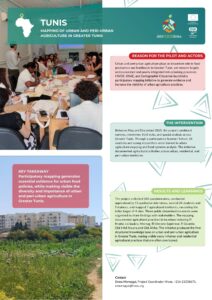
3) Participatory mapping generates essential evidence for urban food policies, while making visible the diversity and importance of urban and peri-urban agriculture in Greater Tunis.
4) School gardens are powerful tools for environmental education and food literacy, while demonstrating how nature-based and traditional water-management solutions can support climate resilience in urban schools.