Placing people at the center: embedding equity in circular food systems
How SMEs across African cities, and partners as far away as Austin, Texas are rethinking fairness in the food value chain.
This blog was written by Paola Castañeda Rodriguez, edited by Matteo Bizzotto (ICLEI World Secretariat).
Circular food systems are often framed in technical terms: reducing waste, closing resource loops, and improving efficiency. Yet, as participants in the AfriFOODlinks Circularity & Inclusivity Coaching Program have reflected, a truly circular food system must also consider whose voices are included, how trade-offs and co-benefits are managed, and who benefits. Without this broader perspective, circularity risks optimizing systems without transforming them in ways that support both people and planet. As the coaching journey progressed, the focus of the program shifted to how circular approaches can actively reduce, rather than reinforce, inequality.
Photo credit: Kenny Oni for the 2023 African CITYFOOD Month photo competition “Urban Recipes.”
Why equity matters in circular food systems
Equity starts from a simple recognition: people do not begin from the same place. It calls for a fair distribution of resources, opportunities, and decision-making power. Inclusivity means that women, young people, smallholders, informal workers, and low-income residents are not only present in food systems but have agency, contribute to shaping them, and benefit from their outcomes.
For small and medium-sized enterprises (SMEs), this raises practical and sometimes uncomfortable questions:
Are smallholders being paid a fair price?
Do workers have safe conditions and dignified livelihoods?
Is surplus food redirected to communities facing food insecurity?
Are residents involved when new projects or business models are designed?
This is where circular business models intersect with social justice. Moving from intention to action requires practical tools to reflect on equity in daily operations.
Snack seller in Lagos, Nigeria. Credit: Oluwayemisi Onadipe for the 2024 African CITYFOOD Month photo competition “Unsung Heroes.”
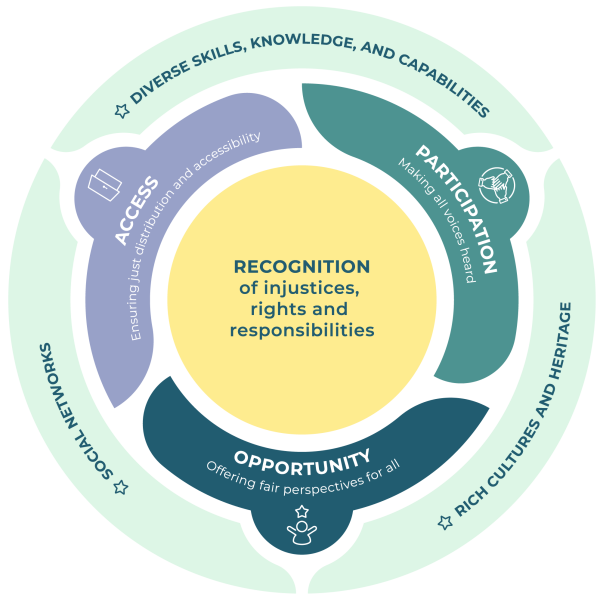
One such tool is the Social Equity framework built around three pillars: Access, Participation, and Opportunity to help SMEs identify where equity can be strengthened in practice. At its core lies the recognition of injustices, rights, and responsibilities, acknowledging the historical and structural inequalities that shape food systems today.
The framework also highlights the importance of community assets, diverse skills, local knowledge, social networks, and cultural heritage as essential foundations for building equitable and circular solutions. Together, these elements provide a clear lens to assess gaps, risks, and opportunities across business operations and value chains.
Source: ICLEI (2025). From Incentivizing to Enabling: a practitioner’s guide to equitable climate action in cities. Bonn/Freiburg.
Access: do people have access to healthy, affordable, locally produced food, and to the infrastructure that supports it?
Globally, food insecurity does not stem from an overall lack of food production, but from barriers related to price, location, and inequitable distribution.
Strengthening equitable access means ensuring that affordable, nutritious food reaches low-income or remote neighbourhoods, reducing food loss and redirecting surplus, improving the environments where food is sold and consumed, and addressing the underlying drivers of poverty that make food inaccessible.
Participation: who gets to shape food systems?
Building equitable food systems requires meaningfully involving those most affected by food system inequalities, such as smallholders, informal traders, women, young people, and low-income residents, in planning and decision-making. This means co-creating solutions from the outset rather than consulting communities after decisions have already been made.
For SMEs, participation can include engaging suppliers in pricing discussions, creating dialogue platforms with traders and customers, involving workers in operational improvements, and partnering with cooperatives or associations to design sourcing and distribution models. Embedding participation in day-to-day practice builds transparency, accountability, and resilience.
Opportunity: are economic opportunities experienced equitably?
This pillar focuses on equitable access to economic, social, and livelihood opportunities across the food system. It invites SMEs to reflect on who benefits from circular transitions, and who may be excluded.
Some SMEs are founded or led by women, young people, or small-scale producers. Others work closely with these groups as suppliers or employees. In both cases, equity means ensuring that value is shared more fairly: that small-scale producers can access higher-value markets, that pricing is transparent, and that workers are paid and treated with dignity.
It also requires addressing structural barriers, such as unequal access to land, resources, finance, and infrastructure, that limit participation in the food economy. Through inclusive sourcing models, fair contracts, and strategic partnerships, SMEs can help ensure that economic opportunities are experienced more equitably across the value chain.
Barriers and opportunities across the food value chain
Inequity in food systems rarely stems from a single issue. It arises from interconnected challenges related to distribution, finance, power, and historical exclusion.
Even where cities produce enough food overall, low-income communities often face hunger or poor diets, while small-scale farmers struggle to access markets dominated by powerful intermediaries and industrialized producers. Climate change, through droughts, extreme weather, and price volatility, further intensifies these pressures. Addressing inequity, therefore, requires shifting decision-making power closer to communities and SMEs, so producers, traders, and consumers have greater influence over how food circulates within cities.
Access to finance remains another critical barrier. While many SMEs are committed to fair pricing and transparent contracts, limited access to affordable credit, thin margins, and market volatility restrict their ability to absorb risks or invest in equitable sourcing practices. Enabling environments, including supportive policies, fair market structures, and accessible finance, are essential for equitable models to thrive.
Examples show that coordinated interventions can make a difference. In Tanzania, shortening supply chains and connecting producers more directly with urban consumers reduced transport costs, increased farmer incomes, and improved access to affordable fresh food, demonstrating how structural changes can advance both circularity and equity.
The role of cities
SMEs cannot advance equity on their own. Cities have a major role to play by creating the enabling environment that allows equitable practices to take root. This can include investing in cold storage and market infrastructure, improving waste and hygiene systems that support informal traders, and using public procurement to prioritize SMEs and local suppliers.
Complementary measures such as transparent contracts, fair pricing mechanisms, and capacity-building for cooperatives, women-led enterprises, and youth groups help redistribute power and strengthen resilience. In Austin, multi-stakeholder boards and community-led collectives help ensure that equity commitments extend beyond individual projects or political cycles.
Austin, United States: River near buildings during daytime. Credit: MJ Tangonan.
Learning across contexts: equity principles from Austin
Despite significant contextual differences, Austin’s approach echoed many of the same equity challenges and solutions discussed in AfriFOODlLinks, as shared by Angela Baucom, Food & Climate Program Coordinator, Austin Climate Action & Resilience
Grounded in an explicit recognition of past racial and economic segregation and aiming to address these, the Austin–Travis County Food Plan is built on a strong principle: food is a human right. Its work is guided by four core pillars: trust-building through transparency and accountability; personalization of engagement to remove participation barriers; mutual benefit that values community knowledge; and a strong focus on racial equity.
Angela emphasized the importance of “ground truthing”, validating plans against lived experience to avoid top-down solutions that overlook community realities. In Austin, this approach has translated into tangible outcomes. For example, regenerative farming initiatives co-developed with refugee communities have not only improved soil health and local food production but also created income opportunities and strengthened social integration. Similarly, textile enterprises using food waste to produce natural dyes have diverted organic waste from landfill while generating green jobs and supporting local creative industries.
From circular to just: the road ahead
Moving from circular to just food systems means making social impacts intentional, ensuring that regeneration also translates into fair incomes, inclusive decision-making, and shared value across the value chain. Equity is not about perfection, but about deliberate choices that strengthen both communities and resilience.
While systemic change takes time, speakers highlighted simple and practical steps SMEs can take immediately:
Be transparent and timely in payments, especially to smallholders and workers.
Listen actively to suppliers, staff, and community voices.
Prioritize local sourcing, particularly from women- and youth-led enterprises.
Invest in capacity-building, so partners can grow alongside the business.
Continuously ask: Who benefits from this model, and who might be left behind?
While circularity gives us the tools, equity gives us the purpose.