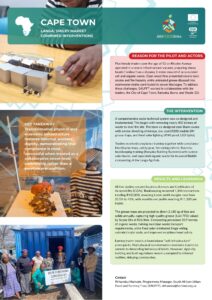
Updated Cape Town pilot interventions
These interventions in Cape Town show how market upgrades can transform food trading spaces into safer, more resilient and inclusive hubs for local economies.
Summary
1) Transformative physical and economic infrastructure restores informal workers’ dignity, demonstrating that compliance is most successful when treated as a collaborative street-level partnership rather than a punitive precondition.
2) Low-cost, mobile safety solutions can build trust with traders and support gradual formalisation while respecting their economic realities and cultural practices.
3) Local innovation in waste management has to be anchored in community-led, multi-stakeholders governance and trust that fosters social ownership, rather than on physical infrastructure alone, and has to align with formal municipal policy to bridge the gap between pilot-phase success and long-term institutional stability.
4) In highly transient transport interchanges, trust is the soft infrastructure prerequisite for behavioural change, and simple activations can catalyse relationship-building before larger-scale structural implementations are deployed.